Human-in-the-loop AI agents: approvals, escalation, and control
How human-in-the-loop AI agents work, which actions need approval gates, when to escalate, and how to add HITL control without blocking routine work.
Written by Northstar
Northstar is an AI agent systems studio. Alex leads engineering and product systems; Jordan leads operations and workflow fit. We ship production agents inside tools teams already use.
Alex Morgan · LinkedIn · Northstar
Direct answer
A human-in-the-loop AI agent automates routine steps but pauses before a person-owned decision or a high-risk action. The human can approve, reject, or edit the proposed action with the evidence needed to judge it. The agent then executes the approved action and records the outcome.
Gate actions that can move money, send external messages, change permissions, publish content, delete data, alter a system of record, or create legal commitments. Keep internal retrieval, ranking, summarization, and sandboxed drafting automatic when they cannot create an external side effect. The goal is to gate the blast radius, not every model response.
Human approval and escalation solve different problems. Approval is a planned checkpoint before a known risky action. Escalation is an exception path used when the agent is uncertain, lacks required data, encounters a policy conflict, or cannot complete the task safely. A production system usually needs both.
Runtime HITL vs training-time HITL
In general, human-in-the-loop means humans participate in the operation, supervision, or decision-making of automated systems (IBM). In machine learning education, that often means training-time work: labeling data, preference feedback (RLHF), or active learning. For production AI agents, runtime HITL is different: the agent proposes a tool action, the workflow pauses, and a human decides before a real-world side effect. This post focuses on runtime control gates, not model-training loops.
Where the human sits in the architecture
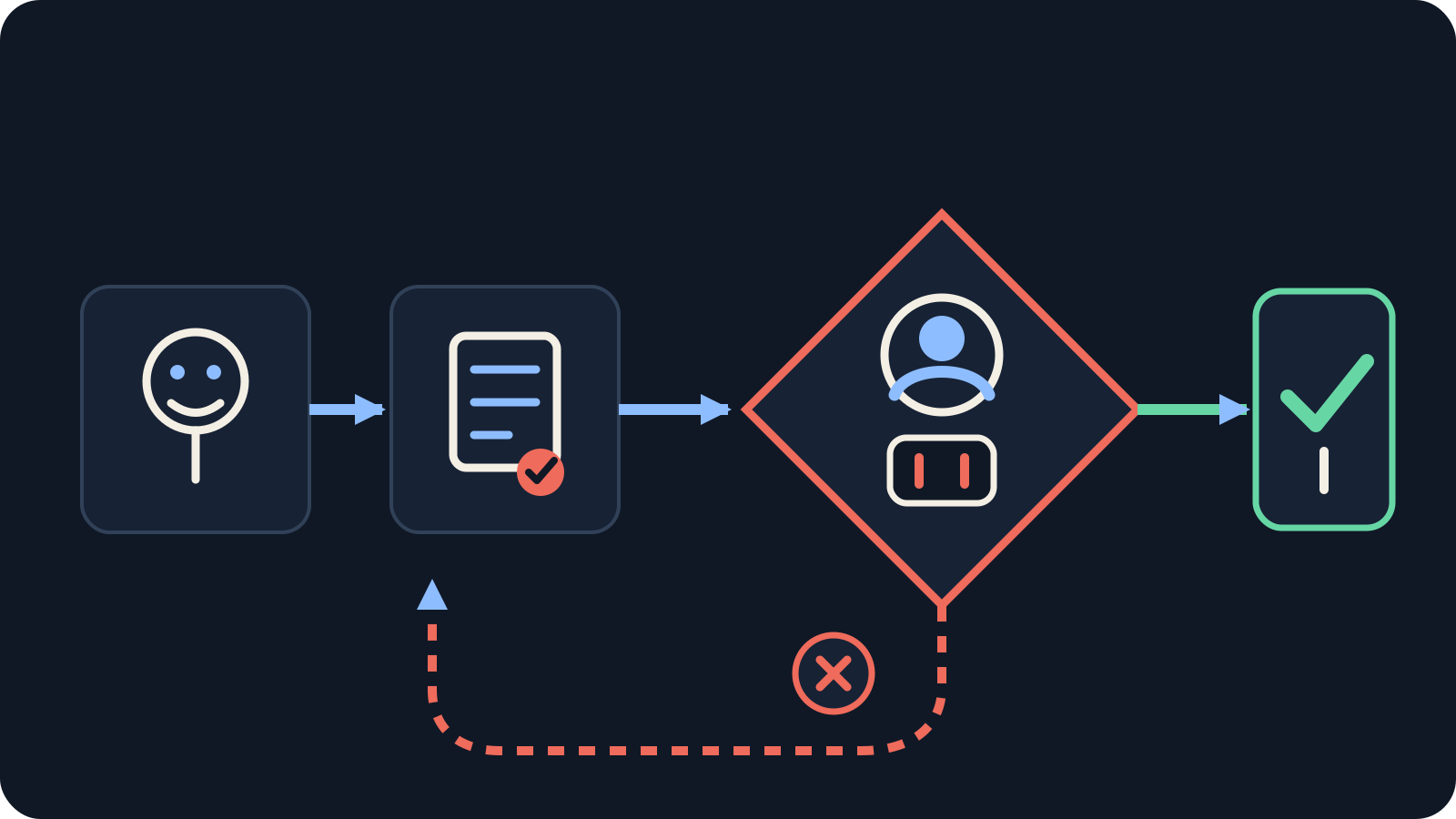
The reviewer needs decision context and evidence at the moment an action can still be paused.
Request
   |
   v
Agent plans -> read-only tools -> evidence pack
   |                              |
   | safe, reversible             | risky, external, uncertain
   v                              v
Auto-execute                 Human review queue
   |                         | approve | edit | reject
   |                         v         v      v
   +--------------------> Controlled action  Escalation
                                  |
                                  v
                         Audit log + outcome metrics
Figure: control-gate flow for human approval in an AI agent system. Safe reversible work can auto-execute; risky or uncertain work enters a review queue before side effects.
The review queue is part of the system, not an inbox added after launch. Each item should show the source request, proposed action, relevant records, policy checks, confidence or uncertainty signals, and the consequence of approval. The approver should not need to reconstruct the agent's reasoning from raw logs.
A practical split is propose then commit: the agent returns a structured intent and parameters; a human (or policy) may edit them; only then does the application execute the tool call. Platform products express the same idea as user confirmation before critical tools, or return of control so the app runs the action after human input (AWS Bedrock Agents user confirmation; return of control). Use those as pattern language, not as a requirement to adopt a specific cloud product.
Actions that usually need a gate
- External sends: email, chat replies, invoices, notices, and bulk outreach.
- Money: payments, refunds, credits, pricing changes, and purchase orders.
- Access: role changes, credential issuance, account suspension, and production deploys.
- Systems of record: CRM stage changes, closing tickets, inventory updates, and destructive database writes.
- Public or regulated content: publishing, legal language, medical or financial claims, and sensitive customer replies.
- Irreversible operations: deletes, cancellations, contract acceptance, or an action whose rollback is slow or incomplete.
Low-risk work can remain automatic when it is reversible and contained. Examples include retrieving documents, classifying a ticket, drafting a reply that cannot be sent, ranking leads for a salesperson, or summarizing a call for the person who already owns the next step.
Approval or escalation: the decision table
| Situation | System response | Human role | Resume condition |
|---|---|---|---|
| Known high-risk action | Request approval before execution | Approve, edit, or reject | Explicit decision from an authorized role |
| Missing required data | Escalate without proposing a side effect | Supply data or choose a fallback | Required fields or a documented exception |
| Policy conflict | Stop and escalate | Resolve which policy controls | Recorded policy decision |
| Low confidence on a reversible task | Continue or sample for review, based on policy | Review sampled outcomes | Threshold remains inside limits |
| Repeated tool failure | Stop retries and escalate | Repair integration or handle manually | Tool health restored or manual completion |
| Safe, deterministic step | Execute automatically | No synchronous review | Normal monitoring only |
Confidence alone should not determine whether an action is gated. A high-confidence model can still be wrong, and a low-confidence classification may be harmless if a human makes the final decision. Risk comes from the action, its reversibility, and its impact.
Minimal approval-gate design
- Name the exact action and its maximum blast radius.
- Define the policy using observable conditions, not a vague instruction to "use judgment."
- Assign the approver by role and permission, not by whoever happens to be online.
- Build an evidence pack with inputs, intended side effects, sources, validation results, and a preview of what happens if the human approves.
- Offer approve, reject, and edit paths, with a reason captured for each decision.
- Set an SLA and a stale-item path so queued work does not disappear silently (remind, reassign, complete manually, or cancel safely; never silent auto-execute on expiry alone).
- Log the proposal, reviewer, decision, final tool call, and result under one correlation ID.
- Measure override rate, queue time, incidents, and successful completion before loosening the gate.
The same pattern is one of the defining controls around a production AI agent. It should be designed together with tool permissions, evals, observability, and the stop switch.
Orchestration stacks that support durable pause and resume make this easier in code (for example, human-approval workflows with signals and timers in Temporal's HITL cookbook). The product choice is secondary to the policy: named owner, evidence pack, SLA, and no auto-execute solely because time ran out.
Maturity patterns beyond a single gate
Once a baseline gate works, you can stage more advanced control without rewriting the whole agent:
| Stage | Pattern | When it helps |
|---|---|---|
| Baseline | Single approval before a named side effect | Default for external, financial, access, or irreversible actions |
| Dual control | Two authorized roles for high blast radius | Payments above a threshold, production access, regulated publish |
| Sampled review | Auto-execute low-risk classes; sample a share for audit | Volume grows but residual risk stays measurable |
| Exception-only | Human only on policy misses, tool failure, or anomaly | Mature paths with stable override and incident rates |
| Propose / commit split | Intent and parameters editable before commit | Reviewers fix bad parameters without full reject-and-restart |
These stages are optional. Do not jump to exception-only review until logs show the action class is safe under real load. Some actions should stay dual-approved permanently.
Oversight context (not legal advice)
Human oversight appears in public risk frameworks as a design goal, not as a one-click compliance checkbox. Under the EU AI Act, Article 14 addresses human oversight for high-risk AI systems so natural persons can oversee operation and intervene when needed (Article 14 text; optional institutional framing: EC AI Act service desk on Article 14). In the United States, the NIST AI Risk Management Framework is a voluntary approach to mapping, measuring, and managing AI risk, including human oversight as part of trustworthy operation (NIST AI RMF hub; AI RMF 1.0 PDF).
This article does not determine whether any reader's system is high-risk under the EU AI Act, or whether a gate design is "compliant." Treat regulation and frameworks as context while legal counsel owns applicability. For production agents, the engineering translation is concrete: pause before impact, give a competent reviewer usable evidence, log the decision, and keep a stop path.
Common failure modes
Gating everything
If every internal draft requires approval, the agent becomes a slow chat interface and reviewers start clicking approve without reading. That rubber-stamping risk is a known limitation of broad HITL designs (Databricks on HITL limitations). Move the gate to the first meaningful side effect.
Gating nothing
One wrong tool call can create hundreds of customer messages or corrupted records before anyone notices. Start conservative on external and irreversible actions, then loosen controls using measured results. Related production agent failure modes often start with unbounded tools and no human stop.
Treating escalation as rejection
An agent may need missing information rather than a yes-or-no decision. Give the reviewer a way to add context, route the case, or complete it manually.
No named owner
A queue with no staffing model is not a control. Name the operating role, backup, response time, and the person who can change policy.
Weak evidence packs
Showing only the proposed answer forces reviewers to search other systems and encourages rubber-stamping. Put the relevant source records and policy result beside the action.
No audit trail
Without linked proposal, decision, action, and outcome events, the team cannot diagnose incidents or learn which gates are unnecessary. The observability layer must include human decisions.
Implementation checklist
- Inventory every tool action and mark whether it is external, financial, destructive, regulated, or hard to reverse.
- Define allowed, forbidden, approval-required, and escalation-only action classes.
- Create role-based access for approvers and separate approval from system administration.
- Design the review card with sufficient evidence and a preview of the exact side effect.
- Add idempotency keys so a double approval cannot create a double action (see also idempotency, retries, and queues).
- Set retry limits and route repeated failures to a human-owned exception queue.
- Record decisions and edits as labeled data for evals, not as unstructured chat history.
- Test approve, reject, edit, expiry, duplicate-click, unavailable-tool, and unauthorized-reviewer paths.
- Launch in shadow mode, then canary the gated execution path.
- Review queue time, override rate, incident rate, and false escalations every week.
- Document the stop switch and the process for tightening gates during an incident.
- Only auto-approve a class of actions after its measured risk is inside an agreed threshold; for dual-control or sampling maturity, document the stage and exit criteria before you loosen a baseline gate.
How Northstar uses HITL
Northstar maps the workflow and its exceptions before placing gates. We keep routine, reversible steps moving and put human control at the point where the business already owns a consequential decision. See solutions for the production-path audit and implementation model.
FAQ
No. Approve external or irreversible actions, not every internal draft. If a generated message cannot leave the sandbox, review can happen later through sampling and evals.