Production agent failure modes (and how to design against them)
Production AI agent failure modes operators actually hit: tool misuse, stale context, missing gates, silent degradation. Design controls and detection - with primary sources.
Written by Northstar
Northstar is an AI agent systems studio. Alex leads engineering and product systems; Jordan leads operations and workflow fit. We ship production agents inside tools teams already use.
Alex Morgan · LinkedIn · Northstar
Production AI agents rarely fail because the model is "not smart enough." They fail because the system around the model - connectors, context, permissions, gates, and ownership - is incomplete. Design against wrong-tool writes, stale or unvetted context, missing approval gates, prompt drift without evals, and no human owner. Every production path needs a stop switch and a review loop.
This is a practical operator taxonomy, not an official universal standard. Use it to name what will break, pick design controls before more tools, and know what to measure after launch.
Why demos pass and production fails
A demo is a short happy path with clean inputs and a human watching. Production is multi-step work across real tools: CRM fields, tickets, refunds, inboxes, and permissions that change over time.
The model is one component. The system that breaks first is usually:
- Connectors and auth that rot after the demo week
- Context that is retrieved but never vetted before action
- Multi-step plans where small errors compound
- Autonomy that can write without a named approver
- Metrics that track model verbosity instead of finished work quality
End-to-end success is hard even on public benchmarks. On WebArena, a realistic web-task environment, a GPT-4-based agent achieved about 14.41% end-to-end task success versus about 78.24% for humans on that benchmark set (WebArena paper). That is not a claim about every business agent. It is evidence that multi-step tool use is harder than a chat transcript suggests.
Illustrative compounding math (not a Northstar KPI):
If each step is correct 85% of the time, and steps are independent, ten steps yield roughly 0.85^10 ≈ 20% end-to-end success.
Real workflows are messier than that formula, but the direction is clear: multi-step paths need gates and recovery, not more autonomy alone.
DEMO-ONLY PATH (happy path, human watching)
  Clean input --> Agent --> Tool sandbox --> Fluent answer
       |              |            |
       v              v            v
  no schema rot   no write tiers   no post-run quality gate
  Result: looks successful; production path never designed

PRODUCTION PATH (multi-step, real tools)
  Live request --> Workflow map --> Agent + scoped tools
                        |                    |
                        v                    v
                 Tool of record      Approval gate / stop switch
                        |                    |
                        v                    v
                 Outcome + audit --> Review / eval loop --> Owner on-call
  Failure surfaces: wrong write, stale context, ungated irreversible, silent rework
Figure: demo-only path versus production-gated path. Demos optimize for a supervised happy path; production fails when connectors, write tiers, owners, and review loops are missing.
For the full demo-versus-production contrast, see AI agent demo vs production.
Industry anchors (read carefully)
Use primary sources as shared vocabulary, not as a stats wall.
- Gartner (June 2025) predicts that over 40% of agentic AI projects will be canceled by the end of 2027, citing escalating costs, unclear business value, or inadequate risk controls - not "models are dumb" (Gartner press release).
- Microsoft AI Red Team published a taxonomy of failure modes in agentic AI systems (PDF) and a v2.0 update (v2 PDF). Use the pair as shared vocabulary (v1 baseline plus v2 additions such as goal hijacking, session contamination, and MCP/plugin abuse); mode detail appears in the taxonomy and security map below.
- OWASP documents Excessive Agency in the LLM Top 10 and publishes the OWASP Top 10 for Agentic Applications (2026) plus agentic threats and mitigations.
- MAST (Cemri et al.) analyzes multi-agent failures with 14 modes in three categories across 1600+ annotated traces, with high inter-annotator agreement (κ = 0.88) (arXiv:2503.13657).
These sources are anchors for language and design. They are not a substitute for your workflow map, tools of record, and named owners.
What good looks like
- Workflow map exists before build
- Irreversible actions have owners and gates
- Tools of record are explicit
- Success is defined as finished work quality, not model verbosity
What bad looks like
- Demo theater without production path
- Unowned automations
- Invented metrics instead of operational evidence
If your current agent stack scores closer to "bad," stop adding tools. Map one path, then design gates.
Production failure-mode taxonomy
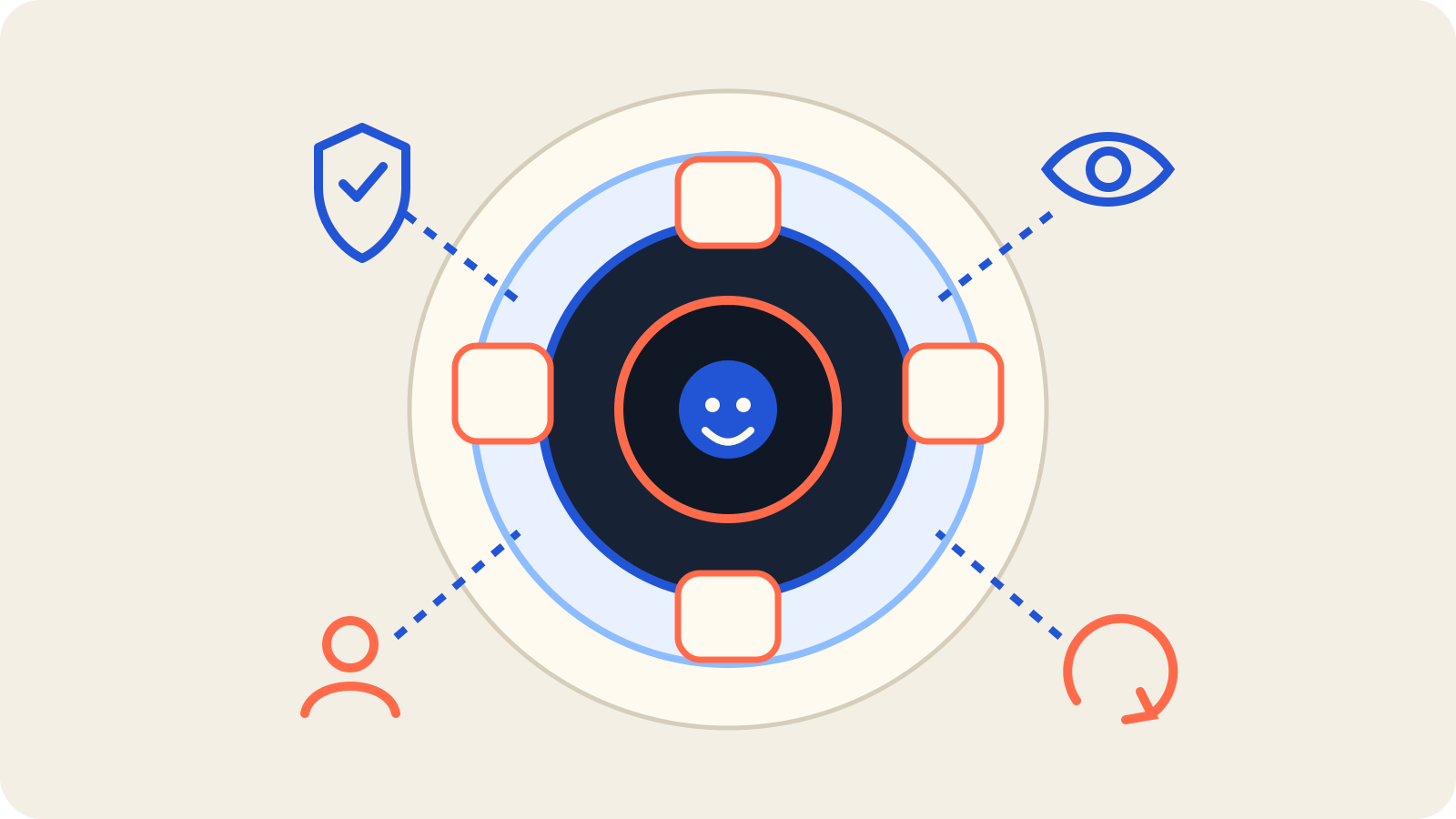
Conceptual containment model: no single guard catches every failure mode, so controls must surround the agent at several independent layers.
The list below is a practical operator set for business agents (CRM writes, support, ops automation). It merges cross-source consensus with production themes. It is not claiming to be the complete industry standard.
1. Tool misuse / wrong writes
The agent picks the wrong tool, wrong arguments, or writes to the wrong record. In a business workflow this looks like updating the wrong CRM contact, closing the wrong ticket, or posting to the wrong channel.
Blast radius: corrupted system of record, customer trust damage, cleanup labor.
Design gate: least-privilege tool scopes; dry-run or draft mode for writes; confirmation on high-impact tools.
Detect: tool-call audit logs with target IDs; post-write validation against expected schema and business rules.
2. Bad retrieval / unvetted context acted on
Retrieval returns stale, partial, or irrelevant context. The agent treats it as ground truth and acts with confidence.
Blast radius: wrong answers that drive wrong actions; silent policy violations.
Design gate: separate "retrieve" from "act"; require citations or source IDs for consequential decisions; allowlist trusted corpora.
Detect: retrieval quality samples; mismatch rates between cited sources and final actions.
3. Brittle connectors (schema, auth, timeouts)
APIs change fields, tokens expire, rate limits appear, or polling traps stall the workflow. Demos use stable sandboxes; production connectors rot.
Blast radius: partial runs, stuck queues, cascading retries, missing updates.
Design gate: health checks, schema contracts, explicit timeout and backoff policy, circuit breakers.
Detect: connector error rates, auth expiry alerts, timeout histograms, dead-letter queues.
4. Compounding multi-step error
Each step is "mostly right," but the joint path fails.
See the illustrative 0.85^n math above.
Blast radius: incorrect end state that no single step flagged as failed.
Design gate: checkpoints after critical steps; replan only within allowed scopes; human gate before irreversible commits.
Detect: step-level success vs path-level success; offline path evals on recorded traces.
5. Context loss / session contamination
Important constraints drop out of the window, or earlier session data biases later steps. Microsoft's agentic taxonomy calls out session context contamination as a distinct mode in its v2 update (Microsoft v2 blog).
Blast radius: policy forgetfulness, cross-customer leakage risk, inconsistent decisions in one session.
Design gate: hard session boundaries; structured state objects; never mix untrusted content into the goal channel.
Detect: context snapshots in traces; unexpected goal or policy changes mid-session.
6. Goal drift / specification drift
The agent pursues a nearby but wrong objective ("help the user" becomes "close the ticket at any cost"). Security-flavored goal hijacking is when untrusted content redirects the terminal goal while looking like helpful task completion (Microsoft taxonomy v2 PDF). Prompt or eval drift without a review loop usually shows up here as goal or specification drift, and later as silent quality misses (mode 8).
Blast radius: completed work that violates the original business intent.
Design gate: immutable task objective; compare plan and actions to the original goal; halt on objective change.
Detect: goal-vs-action reviewers; human re-authorization when the plan changes category.
7. Retry loops and cost explosions
Tool failures or ambiguous success criteria trigger unbounded retries. Token and API spend spike while work still does not finish.
Blast radius: budget burn, rate-limit storms, noisy downstream systems.
Design gate: max attempts, max cost per run, escalate-to-human on budget breach.
Detect: cost-per-success, retry depth, run duration outliers.
8. Silent quality degradation
The workflow returns success. The output looks fluent. Downstream humans or customers absorb the rework later.
Research on silent failure in LLM agent systems studies failures that occur without external adversarial triggers and are easy to misattribute to one-off bugs (silent failure paper).
Blast radius: trust erosion, invisible rework, delayed incident discovery.
Design gate: success = finished work quality checks, not HTTP 200; sampling review on live traffic.
Detect: rework rate, customer corrections, quality rubrics on completed jobs - not chat satisfaction alone.
9. Cascading multi-agent / verification failures
One agent hands bad state to the next. Verifiers rubber-stamp or never run. MAST groups multi-agent failures into system design issues, inter-agent misalignment, and task verification (MAST).
Blast radius: amplified error across roles; hard root-cause attribution.
Design gate: explicit handoff contracts; independent verification on high-impact outputs; start single-agent when multi is not needed.
Detect: handoff schema failures; verifier disagreement rates; path traces across agents.
10. Excessive agency / missing human-in-the-loop gates
The agent has more tools, permissions, or autonomy than the task requires. OWASP frames Excessive Agency around excessive functionality, permissions, and autonomy (OWASP LLM Top 10, project overview at owasp.org).
Blast radius: irreversible actions without consent - refunds, deletes, public sends, permission changes.
Design gate: read / write / destructive tiers with named approvers (see matrix below).
Detect: ungated irreversible actions; HitL skip rate; post-hoc incident review.
Depth on approval design lives in human-in-the-loop AI agents explained.
11. Injection, memory poisoning, tool supply-chain
Untrusted content, poisoned memory, or malicious/compromised tools and plugins steer behavior. Microsoft's v2 taxonomy highlights modes such as agentic supply-chain compromise, MCP/plugin abuse, memory poisoning, and related attacks (Microsoft v2, v2 PDF). OWASP agentic materials cover related application risks (Agentic Top 10 2026, threats and mitigations).
Blast radius: data exfiltration, unauthorized writes, long-lived memory that re-infects later runs.
Design gate: treat tool definitions and memory as supply chain; pin and review plugins; isolate untrusted content from instructions.
Detect: unexpected tool registrations; memory write audits; anomaly alerts on new capabilities.
12. Unowned automations / unclear business value
Nobody owns the bot after the pilot. Success is a slide metric, not a finished-work metric. This is the organizational twin of the Gartner cancel-risk story: unclear value and weak risk controls kill projects even when demos look fine (Gartner).
Blast radius: silent production debt, no incident owner, no kill switch.
Design gate: named human owner per path; stop switch documented; value defined as cycle time, rework, and error rate on one path.
Detect: owner absence in runbooks; no weekly quality review; metrics only about model output length.
Master table
| Mode | Looks like in a business workflow | Blast radius | Design gate / control | How you detect it |
|---|---|---|---|---|
| Tool misuse / wrong writes | Wrong CRM field, wrong ticket close | Corrupted records, customer harm | Scoped tools, write confirmation | Tool audits + post-write checks |
| Bad retrieval acted on | Stale policy used as fact | Wrong actions with confidence | Retrieve ≠ act; source allowlists | Citation/action mismatch samples |
| Brittle connectors | Auth fails, schema drift, timeouts | Stuck or partial workflows | Contracts, health checks, breakers | Error/timeout/auth alerts |
| Compounding multi-step error | Each step "ok," path wrong | Incorrect end state | Checkpoints, path evals | Path vs step success gap |
| Context loss / contamination | Mid-session policy forget or bias | Inconsistent or unsafe decisions | Session bounds, structured state | Goal/policy change in traces |
| Goal / specification drift | Ticket closed, goal missed | Intent failure | Immutable objective, halt on change | Goal-vs-action review |
| Retry loops / cost blowups | Infinite tool retries | Budget and rate-limit damage | Max cost/attempts, escalate | Cost-per-success, retry depth |
| Silent quality degradation | Success flag, bad work product | Hidden rework, trust loss | Quality gates on finished work | Rework, corrections, rubrics |
| Cascading multi-agent fails | Bad handoff, weak verify | Amplified multi-role error | Handoff contracts, independent verify | Cross-agent traces |
| Excessive agency / no HitL | Refund/delete without approval | Irreversible harm | Approval tiers + owners | Ungated irreversible events |
| Injection / memory / supply chain | Poisoned memory or plugin | Long-lived compromise | Tool/memory supply-chain controls | Memory/tool change audits |
| Unowned / unclear value | Orphan bot after pilot | No owner, no kill switch | Named owner, stop switch, path KPIs | Missing runbook ownership |
Irreversible action tiers
Map every tool call to a tier before go-live. Missing gates usually mean everything was treated as "just a write."
| Tier | Examples | Approval default | Owner | Logging |
|---|---|---|---|---|
| Read | Search CRM, fetch ticket, list inventory | Auto allowed within scope | Path owner | Log query + result IDs |
| Write (reversible or low blast) | Draft email, stage CRM update, internal note | Auto or light review by policy | Path owner | Log before/after fields |
| Write (business-critical) | Send customer email, change deal stage, update invoice draft | Human approve or dual control | Business + ops owner | Immutable audit trail |
| Destructive / high blast | Refund, delete, permission change, public post, bulk mutate | Explicit human approval; never silent auto | Risk owner + path owner | Full audit + rollback plan |
Microsoft red-team narrative treats human-in-the-loop bypass as among the most consistently exploited paths in agentic systems (Microsoft v2 blog). In operator language: if consent can be fatigued, skipped, or never wired, the matrix above is theater.
FREE-FIRE PATH (missing gates)
  Request --> Agent --> Write tools (full scope) --> System of record
                              |
                              v
                     No approval, no stop switch
                     Exception = silent retry or ignore
  Outcome: irreversible action lands first; HitL bypass by design

GATED PATH (production default for high blast)
  Request --> Agent plans --> Read / draft tools
                    |
          +---------+---------+
          |                   |
          v                   v
   Safe tier:           Business-critical /
   auto within scope    destructive tier
                              |
                              v
                     Approval / exception queue
                     (named owner)
                     | approve | edit | reject |
                              v
                     Commit to tool of record
                              |
                              v
              Stop switch available anytime
              Audit trail + review / eval loop
Figure: free-fire path versus gated production path. Approval, stop switch, and an exception queue sit before high-blast writes; free-fire treats every write as auto.
Security and agency risks in plain language
Map security vocabulary to business writes and consent - not red-team theater.
| Security / framework term | Operator meaning | First control |
|---|---|---|
| Excessive Agency (OWASP) | Too many tools, permissions, or autonomy | Shrink scopes; gate high-impact actions |
| HitL bypass (Microsoft) | Approvals skipped, fatigued, or never invoked | Hard gates on destructive tiers |
| Goal hijacking | Untrusted content redirects the objective | Separate goal channel from data |
| Session contamination | Early junk biases later steps | Session isolation; sanitize tool output |
| Memory poisoning | Bad facts persist and reappear | Memory write policy + audits |
| MCP / plugin / supply chain | Compromised or over-powered tools | Pin, review, least privilege for plugins |
Start with permissions and gates. Security taxonomy depth without a workflow map still ships wrong writes.
Multi-agent failures (when multi-agent is the wrong fix)
Adding more agents does not fix an unmapped workflow. It multiplies handoffs.
MAST organizes multi-agent failures into three categories (arXiv:2503.13657):
- System design / specification issues - unclear roles, vague success criteria, brittle orchestration
- Inter-agent misalignment - agents work at cross purposes or drop context across handoffs
- Task verification - weak or missing checks on the finished result
Multi-agent is often the wrong fix when:
- You do not yet have one reliable single-agent path on one workflow
- Roles are not specified with tools of record and success definitions
- You have no independent verification step for high-impact outputs
- Ownership is unclear (who restarts the swarm at 2 a.m.?)
For architecture choice detail, see multi-agent vs single-agent.
Detection and measurement
You cannot design against silent failure if success is only "the run completed."
Operator detection map (enough to cluster failures - not an observability product tutorial):
- Trace the path - session ID, plan steps, tool calls, approvals, final business outcome.
- Cluster failures - same wrong tool, same connector error, same quality rubric miss.
- Root-cause in the taxonomy - map the cluster to a mode above.
- Turn production failures into evals - freeze examples that must not regress before the next release.
For instrumentation depth (logs, traces, redaction boundaries), see agent observability: logs and traces.
Measure first on one production path:
| Metric | Why it matters |
|---|---|
| Cycle time | Did finished work get faster end to end? |
| Rework rate | How often humans undo or redo agent output? |
| Error / incident rate | Wrong writes, policy misses, customer-visible failures |
| Ungated irreversible actions | Should be zero outside approved policy |
| Cost per successful completion | Surfaces retry loops and thrash |
Promote these mid-lifecycle metrics before vanity model scores. Pre-launch eval design is covered in how to evaluate AI agents before go-live.
Design checklist (build order)
- Workflow map - real steps, exceptions, tools, and failure cost.
- Tools of record - name the systems that may be written.
- Irreversible tiers - read / write / destructive with owners.
- Human owner - one named person for the path, not "the AI team."
- Stop switch - how to pause the agent without hunting credentials.
- Eval and review loop - offline cases plus live sampling.
- Success definition - finished work quality on one path (cycle time, rework, errors).
[Workflow map]
      |
      v
[Agent + scoped tools] --> [Tool of record]
      |                         |
      v                         v
[Approval gate] <---- stop switch (human)
      |
      v
[Outcome + audit] --> [Review / eval loop]
Figure: build-order summary for a gated production agent path. Map and tools of record come first; the stop switch and review loop stay wired after go-live.
Worked example (hypothetical)
Scenario: A support agent is allowed to update CRM notes and close tickets after drafting a resolution. It is not supposed to issue refunds without approval.
Failure: The agent closes a VIP ticket as "resolved" using a stale FAQ snippet and never creates the promised follow-up task. The run status is success. Two days later the customer escalates; a human reopens the case and redoes the work.
Modes involved: bad retrieval acted on; silent quality degradation; missing write-tier gate on "close ticket" for VIP accounts.
Blast radius: customer trust, SLA miss, rework by senior support.
Design gate: VIP ticket close requires human approval; resolution drafts must cite a current policy document ID; follow-up task creation is a hard post-condition before close is allowed.
Detection: rework/reopen rate on agent-closed tickets; sampling of closed tickets without linked follow-up tasks; rubric fail when cited policy is older than a set freshness window.
No client names - this is a labeled hypothetical for design practice.
How Northstar helps
Northstar designs and implements agent systems with engineering and operations together - from discovery to production paths and AI visibility. We start from the workflow map, tools of record, gates, and owners - not from a larger model or another demo. See solutions and the hub on production AI agents for business.
If agents look fine in demos but create rework in production, map one workflow with gates and owners before adding more tools. Related decision posts: agency vs in-house and agency vs freelancers.
FAQ
No. Tools without a workflow map still fail. Licenses and model access do not name irreversible steps, owners, or success as finished work quality.