Production AI Agents: Definition, Architecture, and Controls
What a production AI agent is, how it differs from demos and chatbots, the five properties that earn production, wrapper architecture, failure modes, and real workflow examples.
Written by Northstar
Northstar is an AI agent systems studio. Alex leads engineering and product systems; Jordan leads operations and workflow fit. We ship production agents inside tools teams already use.
Alex Morgan · LinkedIn · Northstar
Direct answer
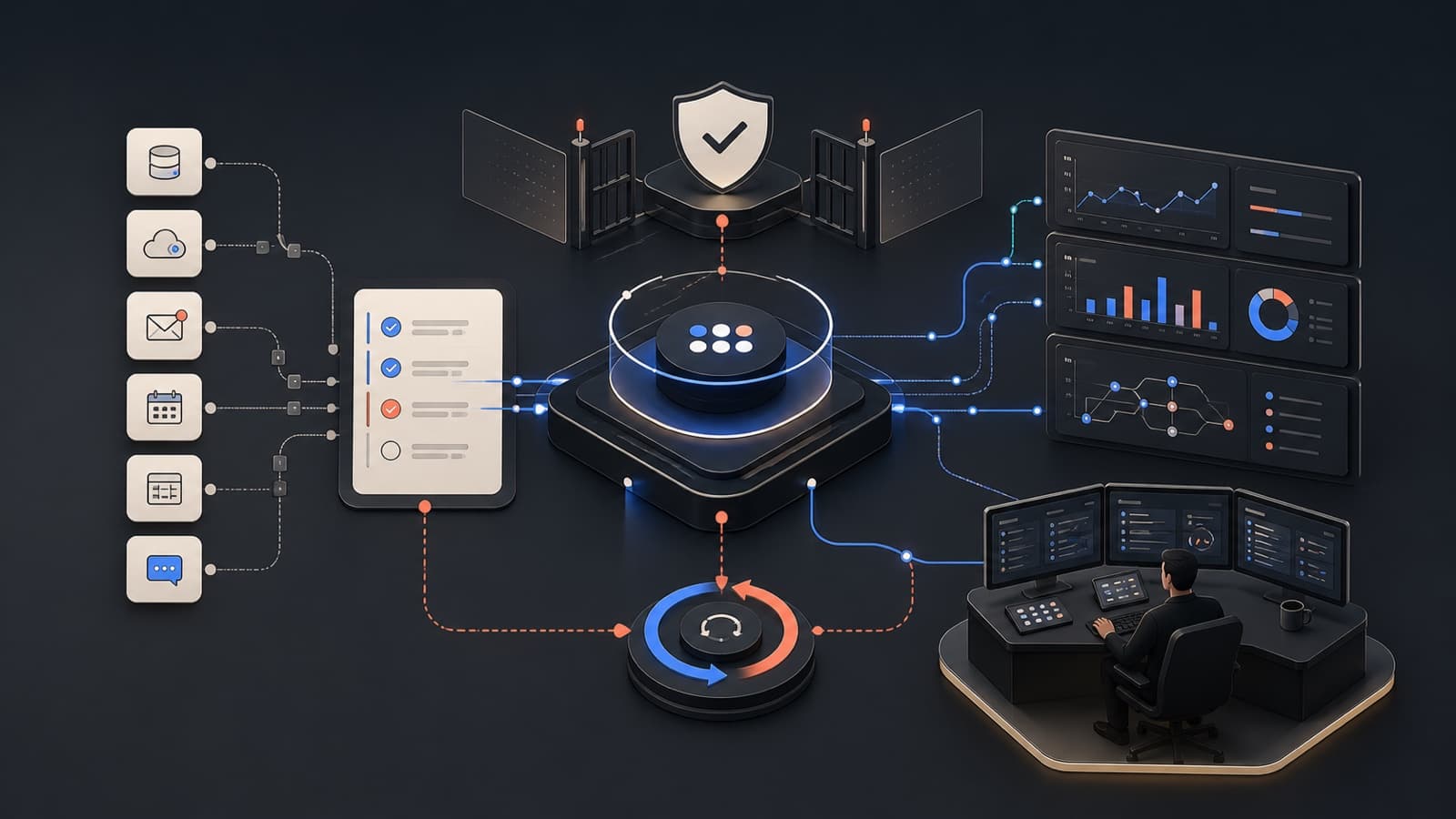
A production AI agent is a system that performs multi-step work inside business tools under scoped permissions, with human approval gates on risky actions, evals that catch regressions, observable execution, and a named owner after handoff. The model is one component; the definition lives in the architecture wrapped around it. A chat window that only talks, however impressive, is a demo.
Under the hood, an agent typically loops: perceive context, plan the next step, act through tools, observe the result, and repeat until the goal is done or a stop condition fires. That loop is the agent. Production is the wrapper that makes the loop safe under real data, real permissions, and real consequences.
This article is the technical and informational pillar: architecture, controls, and examples that make an agent production-ready. If your question is organizational or commercial - where these systems fit, which maturity stage to buy, and how to scope a first pilot - read production AI agents for business. The word "production" is earned by what happens when input is malformed, an API times out, or a customer is angry, not by what happens on the happy path.
The five properties that define "production"
- Acts through tools, under permissions. The agent reads and writes in your CRM, inbox, sheets, or ticketing through scoped credentials, with least privilege enforced. It works inside your tools, not beside them.
- Gated where it matters. Irreversible actions - sending, paying, changing records, closing tickets - route through human approval until evidence justifies loosening. Gates are designed, not bolted on.
- Evaluated continuously. An eval set encodes what good output looks like; regression checks run before any prompt or model change ships. Without this, quality drifts silently.
- Observable. Logs and traces show what the agent saw, decided, and did, readable by your team without the vendor on a call. Incidents get diagnosed in minutes, not reconstructed from memory.
- Owned. A named person operates the review queue, watches the metrics, and can hit the stop switch. Software without an owner degrades into a liability.
Remove any one of the five and you have something weaker than production: a promising prototype, a risky automation, or an unowned liability.
Gates map to an autonomy spectrum in plain language: assisted (human drives; agent drafts or suggests), semi-autonomous (agent acts on low-risk steps; human approves high-risk ones), and supervised (agent runs a path with continuous monitoring, sampling, and a stop switch). Full unattended autonomy is not the default goal for production business workflows. For how approval queues and escalation work in practice, see human-in-the-loop AI agents.
How an agent works (the loop)
A useful mental model is a closed loop, not a single prompt. Generic agent research describes plan-and-act cycling; a production-shaped loop adds grounded context and a permission gate before tool side effects:
- Business input - request, event, or queue item that starts the run.
- Grounded context - policy and source retrieval so the next step rests on real data.
- Plan and validate - choose the next safe action or tool call.
- Permission gate - human approval when the action is risky; low-risk steps may pass under policy.
- Tool execution - scoped, preferably idempotent read or write under credentials.
- Observe and improve - read results, trace, evaluate, retry or stop, then loop if needed.
Research on interleaved reasoning and acting (ReAct) formalizes the plan-and-act core: the model thinks, takes an action, observes, and continues rather than only emitting a final answer (ReAct paper). Platform definitions describe the same shape: agents pursue goals, use tools, and combine planning with action (AWS on AI agents, Google Cloud on AI agents). Tool use / function calling is the primitive that turns text into side effects in real systems (Anthropic tool use).
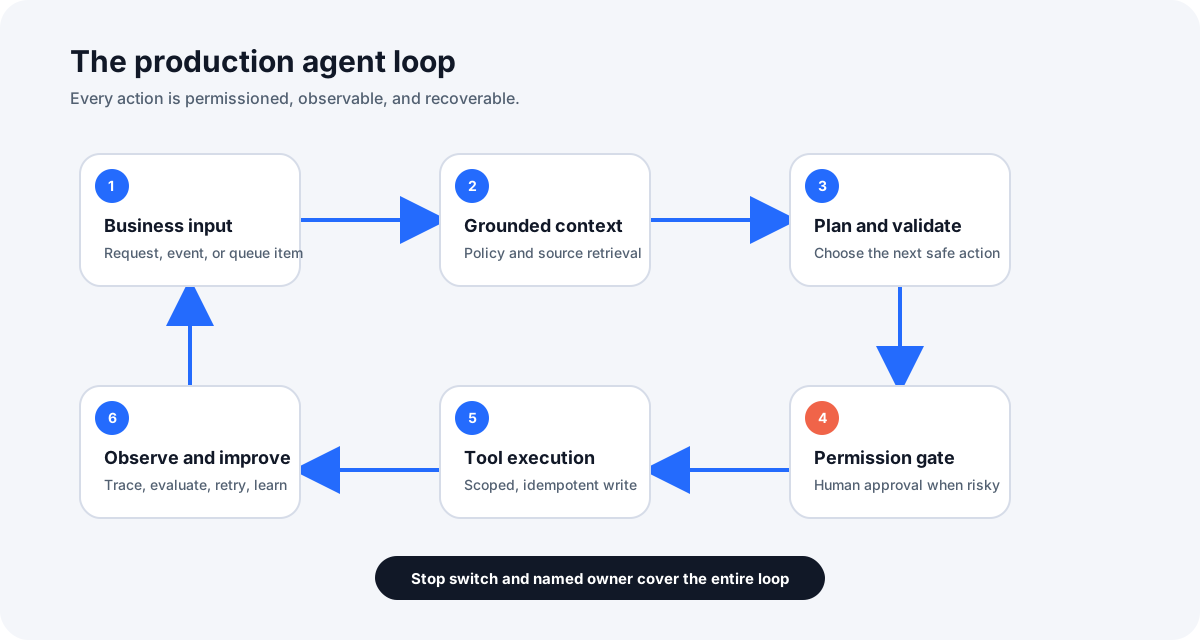
Six stages of a production-shaped loop; the permission gate sits inside the cycle, while evals, traces, ownership, and a stop switch cover the whole path.
The loop is necessary. It is not sufficient. Without the full five properties, you still have a demo that can thrash, overspend, or write into the wrong record.
Demo agent vs production agent
| Dimension | Demo agent | Production agent |
|---|---|---|
| Inputs | Curated, clean | Real, malformed, adversarial |
| Failure path | None; it just stops | Exception queue with a human owner |
| Credentials | Founder's API key | Scoped service accounts, least privilege |
| Risky actions | Executed freely | Gated for approval |
| Quality control | "Looks good" in a call | Eval set plus regression checks |
| Visibility | Console output | Logs, traces, dashboards |
| Rollout | Straight to everyone | Shadow mode, then canary, then scale |
| After launch | Nobody's job | Named owner, runbook, on-call story |
The demo column is not wrong for a demo. It becomes wrong the moment real customer data or real money flows through it. For the operational horror stories that appear when teams skip this gap, see demo vs production.
Production AI agent vs chatbot
| Dimension | Chatbot | Production AI agent |
|---|---|---|
| Primary job | Converse and answer | Finish multi-step work toward a goal |
| Side effects | Usually read-only replies | Reads and writes via tools under permissions |
| Control flow | Scripted intents or free chat | Plans next steps from goals and observations |
| Quality bar | Helpful conversation | Acceptance tests, evals, and override metrics |
| Ownership | Often a content or support surface | Named owner, review queue, stop switch |
| What to evaluate | UI and tone | Gate map, tool contracts, traces, handoff |
A chatbot can sit on the same model family as an agent. The line is action, permissions, and control - not branding. If the system only talks, treat it as a surface, not as a production agent.
Anatomy of the wrapper
The model gets the attention; the wrapper does the work. A production build includes:
- Tool contracts. Explicit definitions of what each tool call may do, with validation on inputs and outputs. Prefer few tools, strictly typed schemas, and idempotent writes where possible.
- Permission scoping. Service accounts per integration, minimal scopes, rotation plan, secrets in a manager rather than code.
- Session and memory. Short-term session state for the current run; long-term memory or retrieval only when the workflow needs it, with retention and access rules.
- Approval gates and review queue. A defined list of gated actions, a queue humans actually work, and criteria for loosening gates over time.
- Exception handling. Timeouts, retries with idempotency, and a dead-letter path so failed work is visible instead of lost.
- Eval set. Representative cases, including edge and failure cases, with pass thresholds tied to acceptance tests.
- Tracing and monitoring. Every run reconstructable end to end; alerts on error rate, latency, and cost. Agent platforms treat tracing of model calls, tools, handoffs, and guardrails as first-class operational signal (OpenAI agents guide, agents observability).
- Cost and token signals. Monitor spend and token use as operational alerts, not only as a monthly budget line after the fact. Set thresholds that match your workflow; do not invent universal numbers.
- Versioning and rollout. Prompts and configs versioned like code; shadow mode and canary before full traffic.
- Stop switch and runbook. One documented action pauses the agent; the runbook says who does what when alerts fire.
- Handoff package. Docs, credentials plan, training, and exit terms, so knowledge survives the vendor relationship.
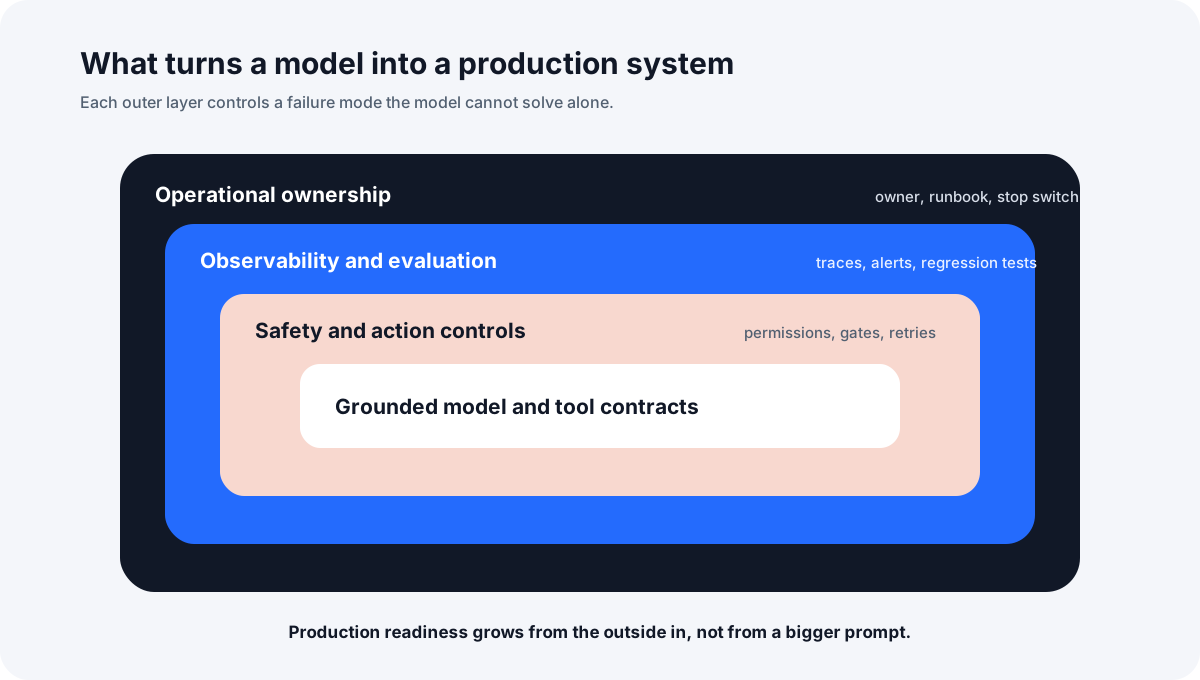
Four nested layers; each outer band controls a failure mode the model cannot solve alone.
Interoperability protocols such as the Model Context Protocol (MCP) can standardize how apps connect tools and data. They are useful plumbing. They are not a substitute for gates, evals, ownership, or a stop switch.
Common failure modes
These failures are why the five properties exist. Keep the catalog short here; depth lives in the failure-modes guide.
- Infinite loops / missing iteration caps - the agent re-plans forever without a timeout or step budget.
- Unscoped credentials - a shared admin key turns one bad action into a wide blast radius.
- Silent quality drift - prompts or models change without an eval suite, so wrong outputs look fine until customers notice.
- Runaway tool spend - recursive tool calls burn tokens or paid APIs with no cost alert.
- Missing or broken tools - the agent invents steps or fails closed poorly when an integration is down.
- Multi-agent cascade - extra agents amplify errors when a single gated path would have been enough.
For design patterns against these modes, read production agent failure modes.
Evaluation, observability, and security
Treat these as three thin requirements, then hand off for depth.
Evaluation. Keep an offline acceptance suite and run regression before every prompt, tool, or model change. Add trajectory review when the path matters: inspect what the agent did step by step, not only the final text. Sample live traffic for drift after go-live (online evaluation), and keep human review in the loop for high-stakes judgments (Microsoft lesson on agents in production, AWS on evaluating agentic systems). Research programs also explore evaluation probes and machine-readable audit trails for agentic systems (NIST evaluation probes for agentic AI); that is a research direction, not a compliance badge. Full go-live method: how to evaluate AI agents before go-live.
Observability. You need logs and traces that reconstruct what the agent saw, which tools it called, what they returned, and what the human decided. If only the vendor can debug a run, you do not own the system. Depth: agent observability: logs and traces.
Security. Enforce least privilege on every tool credential. Sandbox or review tools and skills before they can run in production paths. Audit tool results, not only model text. Keep a stop switch that a named owner can hit without a vendor call.
Production AI agent examples
Illustrative workflow patterns, not case studies:
| Workflow | Agent action | Human control | Production evidence |
|---|---|---|---|
| Lead response | Qualifies a lead, enriches the account, drafts and sends a reply | Approval for sensitive or high-value outbound messages | Reply accuracy, response time, override rate, cost per resolved lead |
| Client inbox | Classifies requests, retrieves account context, updates a ticket | Escalation for policy conflicts and non-standard cases | Resolution rate, queue age, incident count, token spend alerts |
| Operations documents | Extracts fields, validates records, updates an ERP or spreadsheet | Approval for financial or destructive writes | Field accuracy, duplicate rate, trace coverage, override rate |
| Knowledge assistant | Retrieves internal sources and drafts a cited answer | Human owns the final decision when advice has business impact | Citation validity, unanswered rate, stale-source alerts |
These are production examples only when the controls and evidence are real. The same workflow without scoped tools, failure handling, and ownership is still a prototype.
Surfaces are not the system
Chat, email, tickets, voice, WhatsApp, background jobs - these are entry points, not architecture. The same production core can serve several surfaces, and a beautiful chat UI can sit on top of nothing. When a vendor demos a surface, ask what is underneath: the gate map, the eval set, the trace store. The surface is the last 10 percent; buyers who evaluate surfaces buy demos.
How a production agent gets built
A path that reliably produces the properties above:
- Discovery and workflow mapping first, including exceptions.
- Acceptance tests agreed in writing before build.
- Pilot built with gates on from day one.
- Evals run against the acceptance tests.
- Shadow mode on real traffic without acting.
- Canary on a small slice with gates.
- Scale, with gate-loosening decisions made on evidence.
Teams that skip straight from build to full traffic are the source of most agent horror stories. The difference is walked through in demo vs production.
What it means for your organization
A production agent changes jobs, not just tooling. Someone on your side owns quality after the vendor leaves: staffing the review queue, reading the weekly metrics, deciding when gates loosen, and paying the LLM usage line that now sits in your budget. If no one inside the company can be named for this before the build starts, you are not ready to buy one - you are ready to buy a demo, and there are cheaper ways to be disappointed.
In Northstar builds, most of the engineering is not the model call: approval gates, integrations, evals, and monitoring are where the effort goes.
How Northstar fits
Northstar builds the production path first: discovery, gates, evals, observability, and handoff inside the pilot scope, across chat, email, and background-job surfaces. If you have one scoped workflow and an owner for the review queue, start with a production-shaped pilot - not a demo. See solutions for how a pilot is structured, and production AI agents for business for org fit and first-pilot scope.
FAQ
They can be. A copilot that drafts while a human approves every action is effectively a fully gated agent, and that is a legitimate production pattern, often the right first stage. It becomes a production agent in the full sense when it takes controlled actions through tool contracts with the rest of the wrapper - evals, traces, an owner - around it.