Production AI agents for business: what 'production' actually means
A plain definition of production AI agents for business teams: tools, gates, ownership, measurement - not demos.
Written by Northstar
Northstar is an AI agent systems studio. Alex leads engineering and product systems; Jordan leads operations and workflow fit. We ship production agents inside tools teams already use.
Alex Morgan · LinkedIn · Northstar
Direct answer
A production AI agent for business repeatedly completes real work inside company tools, under rules and human gates, with someone accountable when it fails.
Here, "production" means live business operations - real users, real data, real systems - not a manufacturing line and not a polished chat demo.
A demo that only answers questions in a chat window is not production.
This article focuses on business fit, maturity stages, ownership, a business-view deploy path, and measurement.
For the technical definition, architecture, and implementation examples, read Production AI Agents: Definition, Architecture & Examples.
For a shorter demo-versus-live contrast, see AI agent demo vs production.
Production checklist
If any item below is missing, treat the system as a pilot - not production.
- Runs on real cases, not scripted screenshots
- Uses tools the team already lives in (inbox, CRM, docs, chat)
- Has explicit allowed and forbidden actions
- Logs outcomes for review
- Has an owner on-call for exceptions
- Can be paused without a full outage theater
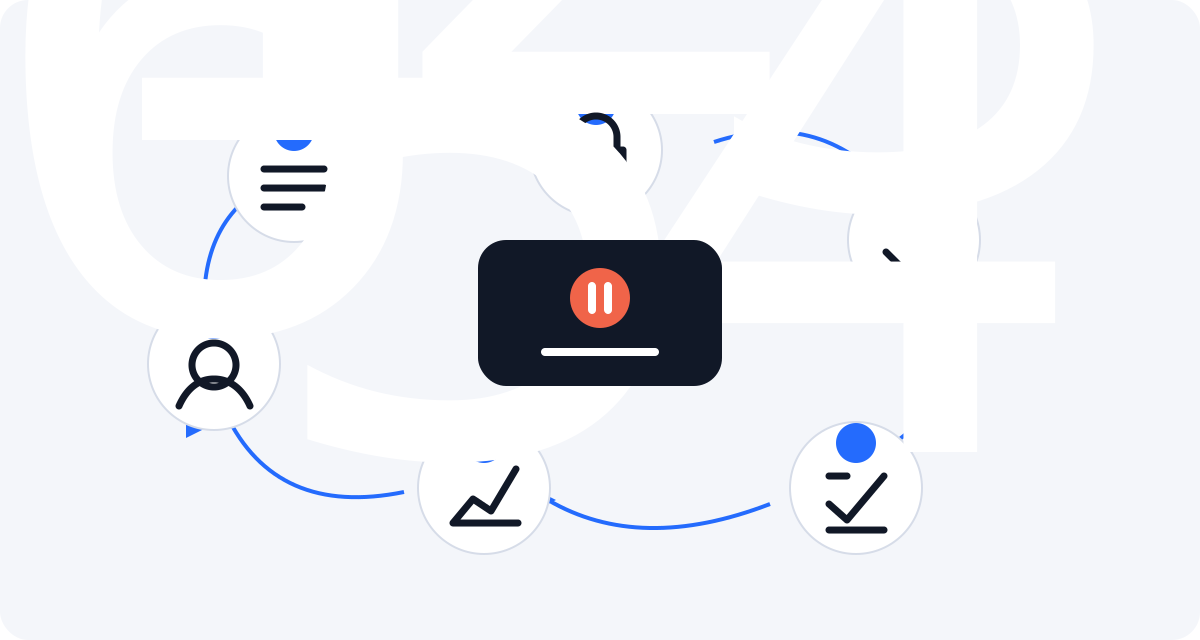
The loop covers tools, permissions, approval gates, evaluation, observability, and named ownership. The center pause control applies to the entire system.
Takeaway: the checklist is the minimum operator bar. Architecture depth lives in the technical sibling; this list is how a business lead decides whether something is actually live.
Market reality: most "agents" are not production
Hype outruns operating systems.
Gartner predicts that over 40% of agentic AI projects will be canceled by the end of 2027, citing escalating costs, unclear business value, or inadequate risk controls.
The same Gartner press release warns about "agent washing": rebranding existing products (assistants, RPA, chatbots) as agentic without substantial agentic capabilities, and estimates only about 130 of the thousands of claimed agentic AI vendors are real.
McKinsey's State of AI survey reports that 23% of respondents say their organizations are scaling an agentic AI system somewhere in the enterprise, while an additional 39% say they have begun experimenting with AI agents.
McKinsey also notes that use of agents is not yet widespread: most organizations that are scaling agents say they are only doing so in one or two functions.
A Cleanlab vendor survey of engineering leaders (data collected August 2025) screened 1,837 respondents and found only 95 with AI agents live in production with real user interactions - and among those production operators, fewer than one in three were satisfied with observability and guardrail solutions.
Treat Cleanlab as a vendor survey with a self-selected production sample, not an independent census of all companies.
Takeaway for operators: curiosity is common; reliable production is still early. That supports staying in gated maturity stages longer than marketing decks suggest.
What production-ready means for business teams
Enterprise guides converge on a simple idea: production-ready means the agent works in a live environment with real users, real data, and real consequences - with guardrails, monitoring, access controls, rollback, and defined success metrics.
Dataiku's production-ready guide frames it that way in plain FAQ language.
IBM defines deployment as moving from prototype or test into real-world operation with real users, data, and systems - then monitoring reliability, accuracy, and interactions after launch.
Google Cloud's production-agent guidance similarly treats prototype-to-production as an engineering and ops path, not a demo handoff.
Use the six-item production checklist as the scannable bar. Expand it with these business criteria before you call a path production-ready:
| Criterion | Pilot / demo | Production |
|---|---|---|
| Users and data | Curated prompts, clean samples | Real cases, messy inputs, edge cases |
| Tools | Mocked or broad founder credentials | Scoped access to tools the team already uses |
| Actions | "Can do anything in the demo" | Explicit allowed and forbidden actions |
| Human gates | Optional or theatrical | Irreversible steps require approval until evidence justifies loosening |
| Evaluation | "Looks good on a call" | Defined success criteria and review samples before scale |
| Logs and observability | Console screenshots | Outcomes and decision paths reconstructable for review |
| Ownership | Shared / nobody | Named owner on-call for exceptions |
| Stop control | Redeploy the whole stack | Pause without outage theater |
| Cost control | Token spend ignored | Cost per successful task watched |
Autonomy is a spectrum, not a badge.
Industry language often maps roughly to assisted, semi-autonomous, and supervised-autonomous behavior (for example in Dataiku's enterprise guide).
Northstar's three maturity stages below are our operator labels for the same idea - not an industry standard.
OpenAI's practical guide to building agents defines agents as systems that independently accomplish tasks on the user's behalf with tools and workflow control - and treats chatbots that only talk as non-agents.
Takeaway: production-ready is a system property (tools, gates, owner, logs, pause, measurement), not a model brand.
Three maturity stages
- Draft assist - agent prepares, human executes
- Gated execute - agent proposes actions, human approves irreversible ones
- Supervised autonomy - limited auto-actions with monitoring and rollback
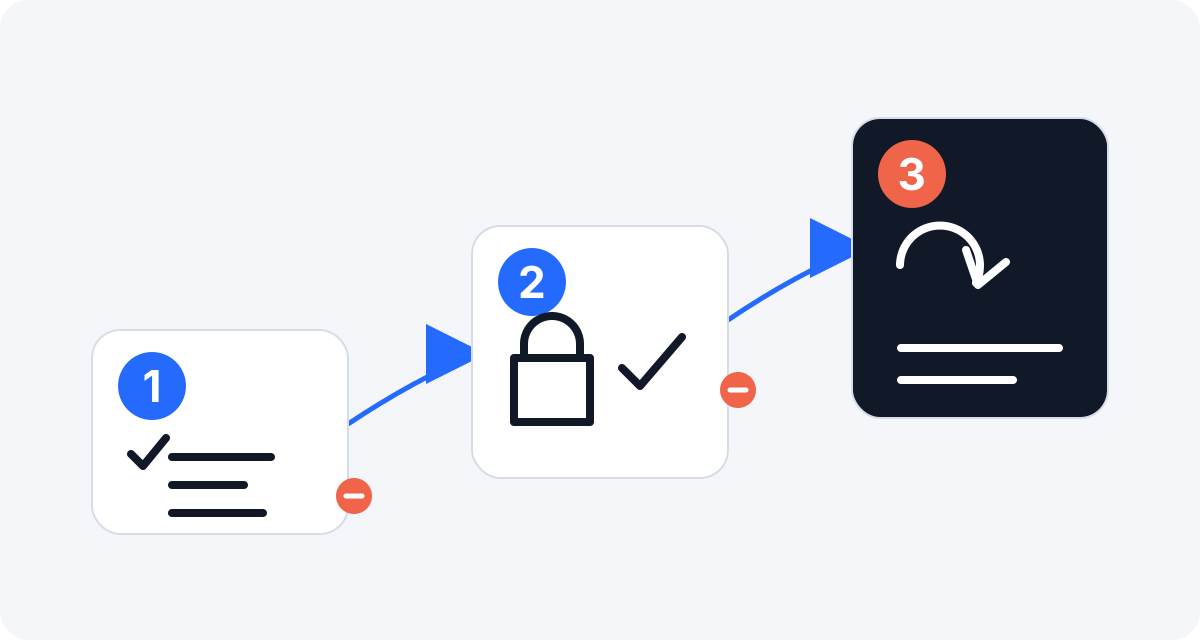
Draft assist, gated execution, and supervised autonomy are separate operating stages. Promotion happens only after the current stage meets its exit criteria.
Most companies should stay in stages 1-2 longer than vendors suggest.
These stages map loosely to assisted / semi-autonomous / supervised-autonomous language used in enterprise writing. They are Northstar's maturity labels for business decisions, not a standards body taxonomy.
Exit criteria before you move up
Leave Draft assist only when:
- The team has a written definition of "done" for the workflow
- Review samples show the draft quality is good enough that humans rarely rewrite from scratch
- Tools and data access for drafting are scoped and logged
Leave Gated execute only when:
- Irreversible actions are listed and gated consistently
- Acceptance and revert rates are measured
- The on-call owner can handle the exception queue without heroics
- Pause works without taking down adjacent systems
Enter Supervised autonomy only for a narrow action set when:
- Task success and plan adherence hold on real traffic, not demos
- Cost per successful task is stable
- Rollback and pause are practiced, not theoretical
- Business owners accept the residual risk in writing
Takeaway: autonomy is earned with evidence. Promoting stages without exit criteria is how cancelation risk shows up later.
Business fit and when not to build an agent
Production agents pay off on high-volume, rule-heavy work with clear "done" criteria:
- Lead response and qualification handoffs
- Inbox and ticket triage
- Ops documentation and field extraction into systems of record
- Knowledge retrieval with citations for internal answers
They struggle on pure strategy, ambiguous negotiation, and brand-new processes nobody understands yet.
Function-level examples (generic)
- Support triage: classify, attach account context, route or draft a reply; human owns refunds and policy exceptions.
- Lead response: enrich, draft first reply, update CRM fields; human owns pricing and commitment language.
- Docs / ops: extract fields, validate against rules, propose writes; human approves financial or destructive updates.
- Knowledge with citations: retrieve internal sources and draft an answer with links; human owns advice that has business impact.
When not to build an agent
OpenAI's guide is clear: agents fit workflows where traditional deterministic and rule-based approaches fall short - complex judgment, brittle rule sprawl, or heavy unstructured data.
If a stable rules engine, form workflow, or fixed RPA path already solves the problem with clear criteria, prefer that.
An agent adds value when context, exceptions, and multi-step tool use matter more than a fixed checklist.
Also skip or delay agents when:
- There is no named owner for exceptions
- "Done" criteria are undefined
- The team cannot grant least-privilege tool access
- Nobody will review samples weekly
For more anti-fit detail, see When not to use AI agents.
Takeaway: fit is about workflow shape and ownership, not model novelty.
How teams deploy (business view)
Deployment is not "we finished the demo."
IBM separates development (build and test) from deployment (real users, real systems, ongoing management).
For a business team, keep the path operator-simple:
- Pick one workflow with high volume and clear done criteria.
- Map the workflow - steps, tools, handoffs, exceptions.
- Define allowed and forbidden actions and which steps need human-in-the-loop approval.
- Name the owner who runs the review queue and can pause the agent.
- Validate on real cases before broad access - not only happy-path screenshots.
- Integrate logging and pause so incidents are reconstructable and stoppable.
- Pilot with a fixed scope and time window, then scale only when KPIs hold.
Architecture choices (topology, model strategy, fallback, state, orchestration) matter, but they belong in the technical path.
Use what is a production AI agent for wrapper design, evals, and controls.
Use a pilot scope template when you need a written boundary for week one.
Takeaway: deploy means real workflow + gates + owner + logs + pause + measurement window - not a launch email.
How to measure production agents
If you cannot measure success, you cannot defend scale.
Google Cloud's KPI framework for production AI agents organizes measurement around three pillars: reliability and operational efficiency, adoption and usage, and business value.
That framework is Google Cloud's framing, not Northstar IP. Adapt it in plain English for business teams:
| Pillar | What you are asking | Example metrics |
|---|---|---|
| Reliability | Does the agent complete the job correctly and consistently? | Task success rate, plan adherence, tool selection accuracy, error / escalation rate |
| Adoption | Do people use it without fighting it? | Acceptance rate, edit rate, revert / undo rate, time-to-verify, active use in the target team |
| Business value | Does the business get faster or cheaper outcomes? | Time-to-done, backlog age, cost per successful task, manual steps removed |
Cost control belongs next to reliability.
Google Cloud emphasizes cost per successful task rather than tokens alone: a cheap failed run is still expensive.
Watch for token runaway, retry loops, and tool call storms.
For deeper ops measurement patterns, see measuring AI agent ops and AI agent ROI.
For logging and traces that make reliability measurable, see agent observability: logs and traces.
Takeaway: start with reliability and acceptance before you market ROI slides.
If you are ready to turn measurement into a first pilot boundary, use the pilot scope template or map one workflow before expanding access.
Worked example: gated lead-response path (hypothetical)
This is an illustrative / hypothetical workflow, not a named client case.
Goal: first response to inbound leads within a fixed SLA, with CRM fields updated and no unsupervised pricing promises.
Tools the agent may use:
- Read CRM contact and recent activity
- Read product FAQ knowledge base
- Draft email reply in the shared inbox tool
- Propose CRM field updates (stage, notes, owner)
Allowed actions (agent may prepare without separate approval):
- Classify lead intent
- Draft a first reply using approved templates and FAQ snippets
- Propose CRM notes and stage change
Forbidden without human approval:
- Send the email
- Commit discounts or custom pricing language
- Delete or merge CRM records
- Message channels outside the approved inbox
Human gate:
- Sales owner reviews draft + proposed CRM updates
- Approves send, edits, or rejects
Logs:
- Input summary, tools called, draft version, approver decision, final outcome
Owner on-call:
- Sales ops lead owns exceptions (missing CRM data, angry replies, policy edge cases)
- Engineering on-call owns tool failures and pause
Pause:
- Toggle stops new drafts without taking down the CRM or inbox
Consulting narratives often show a similar pattern: gather data, analyze, recommend, then update platforms with human approval (see BCG's campaign-style agent illustration on their AI agents page - use as a process pattern only, not as a promised ROI figure).
Takeaway: the value is the gated loop, not unsupervised send.
Governance and anti-patterns
Production governance is boring on purpose.
From enterprise practice (Dataiku, IBM, OpenAI):
- Least privilege - tools and data only for the workflow
- Audit trails - who/what/when for tool calls and approvals
- Input and output guardrails - scope, safety, PII where relevant
- Human review samples - scheduled, not only after incidents
- Kill / pause switch - controlled disable without theater
- Evaluation before scale - success criteria written before traffic expands
Anti-patterns
- Calling a chat UI an "agent" with no multi-step tool actions (agent washing risk)
- Multi-agent orchestration on day one with half-wired specialists
- No named owner for exceptions
- Demo screenshots treated as production evidence
- Unsupervised irreversible actions (send, pay, delete, legal commit)
- No measurement window and no cost-per-success view
- Broad admin credentials "just for the pilot"
- Scaling stage 3 autonomy because a vendor demo looked autonomous
Takeaway: governance is part of the product. Bolt-on policy after launch is how cancelation risk becomes real.
How Northstar approaches production systems
We design agent systems around workflows and approval boundaries, then implement.
That order matters more than model fashion.
Related reading in this cluster:
- Map workflows for AI agents
- Human-in-the-loop AI agents explained
- What is a production AI agent (architecture and controls)
- AI agent pilot scope template
If you want a structured next step with Northstar, start from solutions and bring one real workflow, not a feature wishlist.
FAQ
Only if it takes multi-step actions with tools under workflow control. Chat alone is an interface. [OpenAI's definition](https://openai.com/business/guides-and-resources/a-practical-guide-to-building-ai-agents/) treats applications that use LLMs without controlling workflow execution as non-agents.