AI agent demo vs production: the real difference
Clear contrast between AI agent demos and production systems: tools, permissions, gates, evaluation, failure handling, and a buyer test vendors fail.
Written by Northstar
Northstar is an AI agent systems studio. Alex leads engineering and product systems; Jordan leads operations and workflow fit. We ship production agents inside tools teams already use.
Alex Morgan · LinkedIn · Northstar
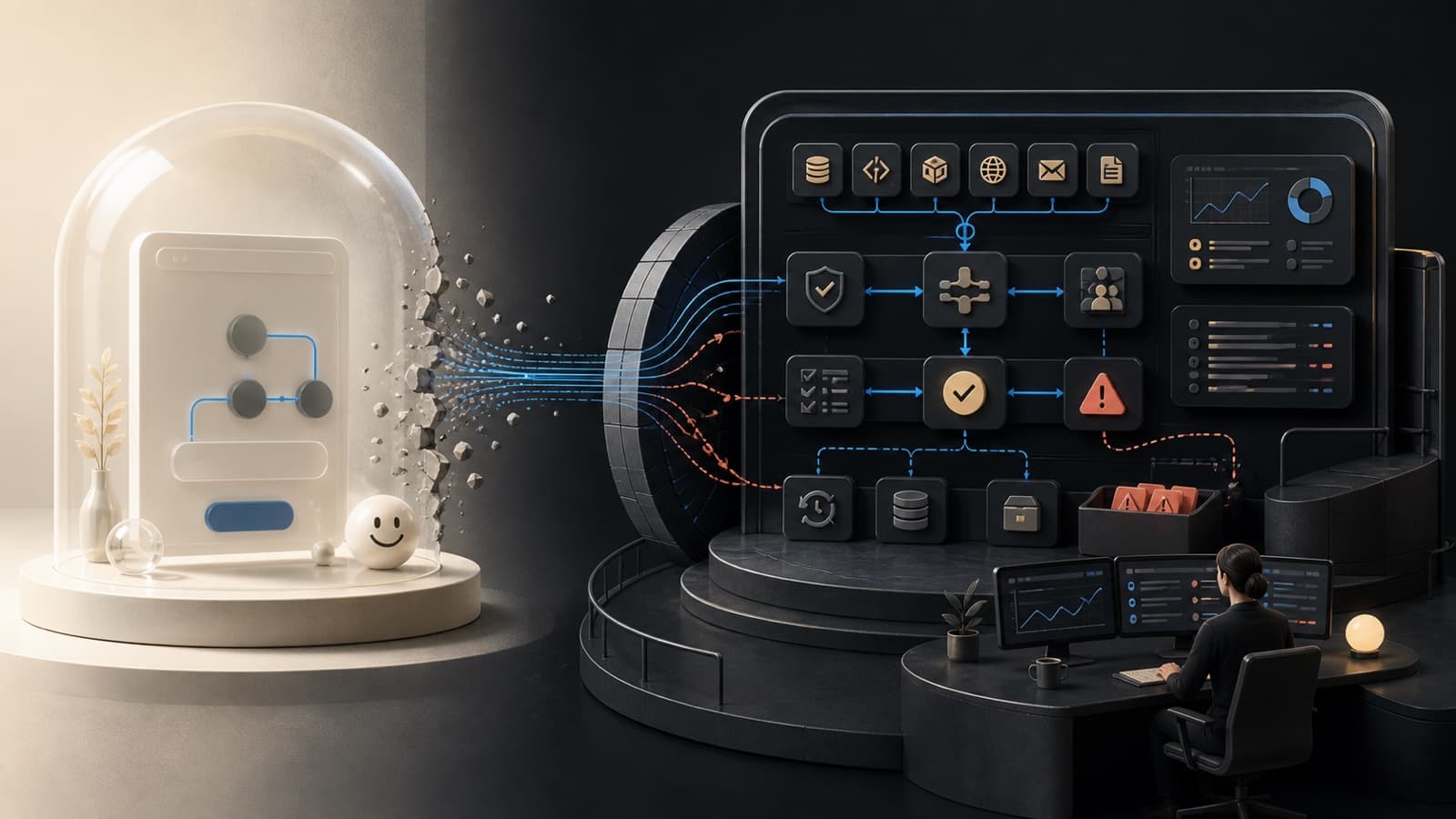
A demo impresses in a meeting. Production survives bad inputs, limited permissions, human gates, and Monday morning exceptions. The gap is not "more polish on the chat UI." It is whether the system still behaves under your constraints when nobody is staging the prompts.
For the full control set behind that claim, start with the production AI agent definition and architecture. Buy production design, not demo polish.
Demo vs production at a glance
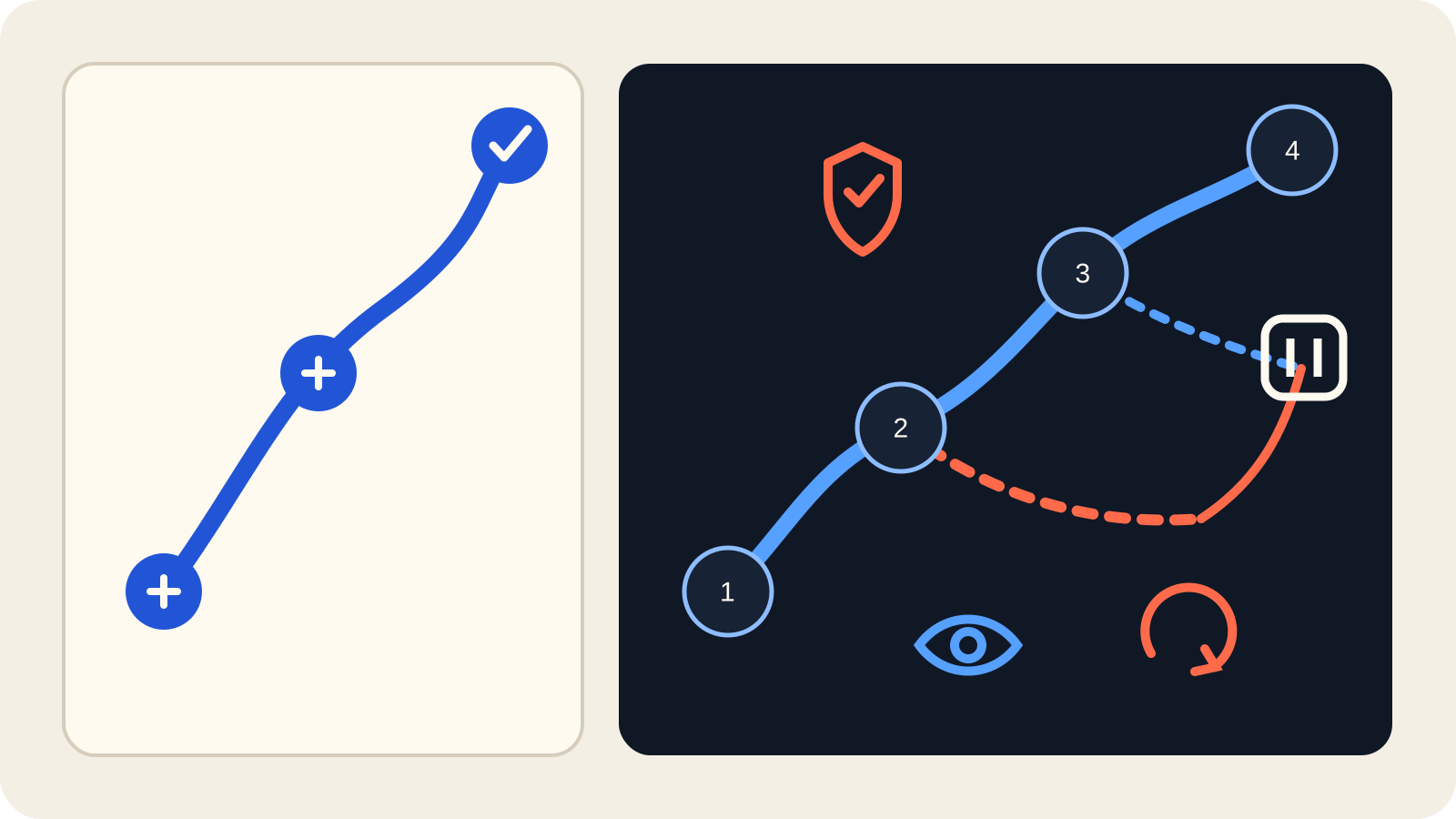
Conceptual diagram: a demo proves one polished path; production readiness adds controls, observability, failure branches, and recovery.
Use this table when you watch a vendor demo or review an internal prototype. It maps the usual demo shortcuts to the controls production actually needs.
| Dimension | Demo | Production |
|---|---|---|
| Inputs | Scripted, clean prompts and happy-path tickets | Real, messy, incomplete, and adversarial inputs |
| Permissions / tools | Broad credentials (founder keys, admin OAuth) | Least-privilege scopes per tool and environment |
| Human gates | None, or "we can add approval later" | Approvals on irreversible actions (send, pay, change records) |
| Logs / observability | Console output or no logs | Reconstructable traces: decisions, tools, cost, outcomes |
| Evaluation | "Looks good in the call" | Eval suite before go-live and after every model/prompt change |
| Failure / cost | Stops or retries blindly; no budget story | Known failure modes, fallbacks, and spend limits |
| Ownership / kill switch | No named owner; no docs | Named owner, ops metrics, runbook, docs, and a real kill switch |
Caption: Decision table for AI agent demo traits versus production controls. If a row is empty on the production side, you are still looking at a demo.
Why demos work and production fails
Demos optimize for meeting success. Someone picks friendly tickets, broad API keys, and a path the model already handles well. The room applauds because the script works.
Production fails for the opposite reasons. Inputs are unpicked: typos, missing fields, angry customers, partial CRM records, and edge cases nobody rehearsed. Credentials should be narrow, so a single tool error cannot wipe or expose more than it should. Multi-step agents also compound mistakes: each weak step multiplies risk across tool calls, which is why Anthropic recommends simple composable patterns, extensive testing in sandboxed environments, and guardrails before you lean on open-ended autonomy (Building effective agents).
Takeaway: a demo that only works on the happy path is expected. Calling that path "production ready" is the failure.
Chatbot demo vs agent system
A narrow Q&A chatbot can be production-ready with a smaller blast radius. It answers from a knowledge base, hands off to a human, and does not rewrite your systems of record.
An agent demo with tools is a different risk class. It can create tickets, update CRM fields, send messages, or trigger workflows. That is the chatbot-demo vs agent-system distinction that matters for buyers: same meeting polish, much higher consequence when permissions are real.
If the demo only chats, judge it as a support surface. If the demo acts, judge it as a system that can hurt people and data when it is wrong.
How vendors blur the line (agent washing)
Vendors often host the demo on your logo theme, your colors, and a sample of your FAQ. That is branding, not production.
Industry and agency writing sometimes call this agent washing: shipping a polished demo labeled as production without evaluation, observability, least-privilege tools, failure handling, or a runbook. Plain version: a demo on your branding without your constraints is still a demo.
Watch for these patterns:
- Credentials are "temporary admin" that never get scoped down.
- Failures are waved off as "we will add retries in phase two."
- Logs stop at chat transcript; tool calls and cost are invisible.
- There is no named owner after the pilot ends.
- The only "eval" is a slide with green checkmarks from the sales call.
If those constraints are missing, you bought theater with a deployment date attached.
Buyer tests: questions that scrub the demo
Do not accept a clean sample as proof. Run tests a vendor or internal team cannot stage in five minutes.
- Replay last month's messy tickets - not a golden path. Pick real exceptions: refunds, policy edge cases, incomplete data, angry tone.
- Show permission scopes - which tools, which environments, least privilege or admin?
- Kill switch drill - who stops the agent mid-run, and how long does it take?
- Eval suite existence - cases, pass bars, and what runs after a prompt or model change. See how to evaluate AI agents before go-live.
- Last incident or failure log - what broke, what the agent did, who noticed.
- Runbook owner - named human for review queue, on-call, and post-incident notes.
- Tool failure and budget limit - what happens when an API times out or spend hits a cap?
Checklist intent: buyer questions to test whether an AI agent demo is production-ready. If answers are vague, you are still in demo mode.
Production signals worth requiring
You do not need a platform whitepaper to demand these signals. You do need them before customer data or money moves through the agent.
- Human gates and oversight. Irreversible actions need approval paths, not hope. OpenAI's practices for governing agentic systems stress accountability and human approval for significant decisions (Practices for governing agentic AI systems). Practical design for gates: human-in-the-loop AI agents explained.
- Trajectory-aware evaluation. Judge the path (tool choice, recovery, clarifying questions), not only the final answer. Google Cloud frames agent evaluation around full trajectories and staged rollout from sandbox to canary to production (A developer's guide to production-ready AI agents; Agent Quality).
- Least-privilege tools. Scoped credentials and authenticated tool access beat founder API keys.
- Security against prompt injection and related LLM risks. Tool-using agents inherit risks catalogued in the OWASP Top 10 for LLM applications, including prompt injection and excessive agency (OWASP Top 10 for LLM Applications).
- Staged deploy mindset. Sandbox internal tests, canary limited traffic, then broader production. Full architecture depth lives on the production AI agent definition post, not here.
- Observable failures. When something breaks, you need logs and traces, not memory. Related cluster reads: production agent failure modes and agent observability: logs and traces.
Hybrid patterns are common in production: deterministic controls and policy for money and compliance steps, LLM judgment where language and routing need flexibility. That is a design recommendation, not a universal law - and it aligns with Anthropic's push to start simple and add agent autonomy only when simpler workflows are not enough (Building effective agents).
How Northstar fits
Northstar ships production paths: discovery, scoped tools, human gates, evals, and ownership after handoff - not demo polish sold as go-live. If you have a prototype that needs production design, see solutions or start a conversation from the site CTA.
We will not invent a case study for this page. The test is the same one we recommend you run on any vendor: messy tickets, real scopes, kill switch, evals, logs.
FAQ
Yes, but only after redesign for gates, permissions, and evals - not after a UI reskin or a logo swap. The model may stay; the wrapper around tools, approvals, observability, and ownership usually must change.