Zapier, Make, n8n vs Production AI Agents: When Workflows Are Enough
When Zapier, Make, or n8n is enough, when platform Agents are still automation with LLM steps, and when you need production agent systems with gates, evals, and ownership.
Written by Northstar
Northstar is an AI agent systems studio. Alex leads engineering and product systems; Jordan leads operations and workflow fit. We ship production agents inside tools teams already use.
Alex Morgan · LinkedIn · Northstar
Direct answer
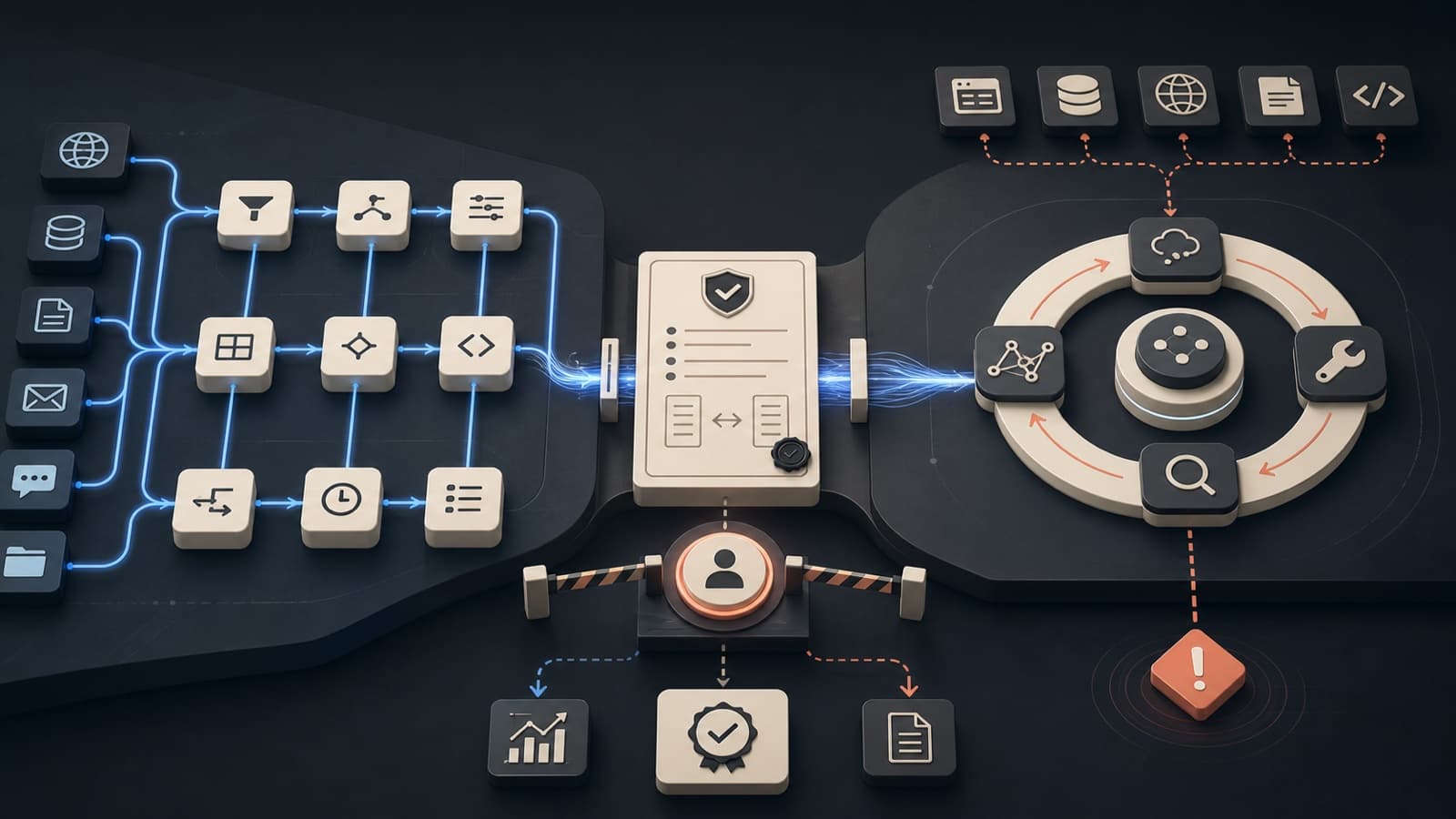
Use Zapier, Make, or n8n for reliable glue between apps with clear triggers and stable field maps. Add production agents when language understanding, messy inputs, and gated multi-step decisions are the job - and you need evals, ownership, and constrained tool access. Most serious stacks are hybrid: deterministic workflow rails for high-volume fixed paths, a judgment step for the ambiguous remainder, then hand-back to routing with human gates on risky writes.
Workflows connect; agents decide
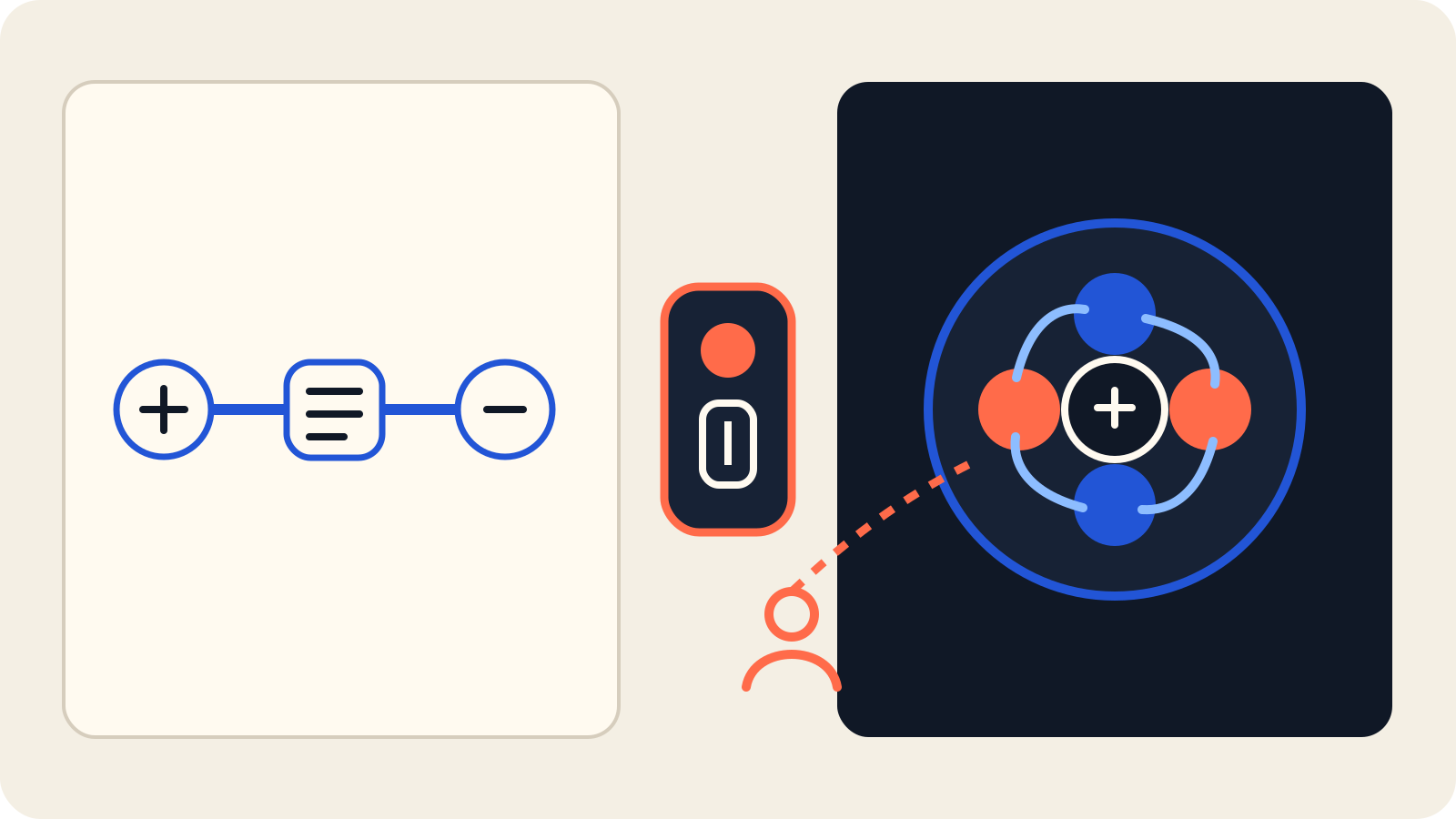
Conceptual boundary: deterministic workflow steps stay explicit, while ambiguous decisions enter a gated agent loop with observation and human control.
A useful split is control flow, not brand marketing. Prompting Guide describes workflows as systems that follow predefined paths, and agents as systems with more dynamic control over what runs next. AWS executive guidance frames the same idea as a spectrum of autonomy: more automation is enough when the path is known; more agent-like systems appear when the path must be chosen under ambiguity.
That does not mean every product labeled "AI agent" is a production system you own. A marketing page can sell agents while the runtime is still platform automation with LLM steps inside someone else's control surface. Treat "agent" as a product word until you can name tool contracts, gates, evals, observability, and who is on call when it fails.
Platform Agents in 2026 (Zapier, Make, n8n)
All three major workflow platforms now ship agent-style products. Ignoring that makes any 2026 comparison look frozen in 2023.
- Zapier Agents - Zapier markets agents that work across its large app ecosystem, with product docs on building and overseeing them (product, help, guide).
- Make AI Agents - Make positions AI Agents against pure scenarios, including transparent reasoning framing and guidance on when an agent is appropriate versus automation that "just needs doing" (product, help).
- n8n AI Agents - n8n markets AI Agent nodes plus guardrails, human-in-the-loop steps, monitoring, and evaluations for AI workflows (product).
Zapier's own comparison of Zapier vs n8n emphasizes managed operations, integrations, and governance axes from Zapier's point of view (Zapier blog). Treat that as vendor positioning, not neutral law.
Takeaway: platform Agents are real and useful. They are still platform rails plus LLM judgment unless you own gates, secrets hygiene, acceptance tests, blast radius, and on-call ownership.
When Zapier, Make, or n8n is enough
Stay on no-code or low-code workflow tools when the job looks like this:
- Stable triggers - form submit, new row, webhook, invoice paid, ticket status change.
- Deterministic field maps - the same inputs map to the same fields every run.
- Low NLP need - you are not interpreting free-form language to decide policy.
- Low blast radius - mistakes are internal, reversible, or cheap to fix.
- Clear exception path - outliers already go to a human queue you trust.
Rough tool roles (not a pricing shootout):
| Platform | Common fit |
|---|---|
| Zapier | Fast glue across many SaaS apps; polished managed ops |
| Make | Visual branching and scenario design |
| n8n | Self-host or stronger control when data residency and code nodes matter |
If the workflow is a $20 Zap problem, do not fund a custom agent program. See also build vs buy automation.
When no-code (and platform Agents) strain
Strain shows up when judgment and risk outgrow the control surface:
- Ambiguous emails and tickets - multi-issue messages, missing context, tone that matters.
- Policy-heavy replies - refunds, discounts, legal wording, brand risk.
- Branching that needs judgment - the path is not fully rule-able in advance.
- Strict audit requirements - you must prove who approved what, with retention you control.
- Write actions to money, customers, or PII - open tool access without gates becomes an incident generator.
- Multi-tenant or regulated paths - platform defaults may not match isolation, residency, or audit rules.
Hypothetical: a support email asks for a delay, a refund, and attaches a damage photo. A Zap can route the message. A platform Agent or LLM step can draft a reply. Neither is "production" until refund amounts and customer writes pass policy gates you own and can evaluate.
30-second decision test
Answer these in order. Stop when the answer points clearly to one layer.
-
Can the full path be written as rules today? Yes → workflow automation (Zapier / Make / n8n). No → keep going.
-
Is input/output shape always the same? Always structured → workflow. Often messy language or documents → judgment layer needed.
-
Is the exception rate low and already staffed? Yes → workflow plus human queue. No, exceptions are the work → agent-style judgment.
-
Does any step write money, customer state, permissions, or PII? Yes → require human approval gates and constrained tools before any autonomous write. No → lower bar, still log and measure.
-
Do you need owned evals, tenant isolation, and on-call ownership beyond the platform? No → platform Agents or n8n + LLM may be enough. Yes → production agent system (often still hybrid with workflow rails).
| Your answers lean... | Start with |
|---|---|
| Rules + stable I/O + low blast radius | Zapier / Make / n8n workflows |
| Mostly rules + occasional judgment | Platform Agent step or LLM node inside a workflow |
| Messy inputs + policy writes + ownership needs | Production agent system with gates and evals |
Comparison table
| Dimension | Workflow automation | Platform Agents (Zapier / Make / n8n) | Production agent systems |
|---|---|---|---|
| Job of the layer | Connect apps on a known path | Add LLM judgment on platform rails | Decide and act under ambiguity with owned controls |
| Determinism | High | Medium (LLM steps vary) | Designed: constrained tools + gates where variance is unsafe |
| Input shape | Structured fields, events | Structured + some free text | Messy language, multi-step context, tools |
| Reliability model | Retries, fixed maps, platform logs | Platform monitoring + prompt/tool design | Evals, acceptance tests, observability, incident ownership |
| Ownership surface | Platform account + zap/scenario design | Same platform + agent config | Your tool contracts, secrets, gates, on-call |
| When to use | Glue, sync, alerts, ETL-like hops | Judgment inside existing automation estate | Risk, multi-tenant, regulated writes, or core product logic |
No cost row: live pricing drifts; re-check vendor pages before any budget claim.
n8n + LLM as a prototype path
n8n plus LLM nodes (or n8n's AI Agent node) is a strong path for demos and internal tools. You can wire triggers, tools, memory, and visual control without starting from a blank framework.
n8n markets production-oriented features such as guardrails, human-in-the-loop approval, monitoring, and evaluations for AI workflows (n8n AI Agents). Those claims describe product capabilities. They do not automatically mean your deployment has secrets hygiene, acceptance tests, on-call ownership, or parity with enterprise eval practice.
To treat n8n + LLM as production, still require:
- Gates on irreversible or high-risk writes
- Secrets hygiene (no admin tokens in browser storage or chat logs)
- Acceptance tests on real ugly cases, not only happy paths
- Clear ownership when the workflow fails at 2 a.m.
Prototype speed is a feature. Calling a prototype "production" without those controls is a labeling problem.
What "production agents" means here
Here, production agents means systems that survive messy inputs and Monday morning exceptions - not a chat demo. For the full definition and architecture, see what is a production AI agent and production AI agents for business.
Short bar (checklist, not a full eval/HITL tutorial):
- Tool contracts - each tool has allowed args, scopes, and failure behavior.
- HITL / human approval gates - risky actions pause for a person (human-in-the-loop AI agents).
- Evals and acceptance tests - real cases before go-live (how to evaluate AI agents before go-live).
- Observability - you can reconstruct what ran, with redaction.
- On-call ownership - a named human owns incidents.
- Tenant isolation - multi-customer or multi-brand data does not leak across contexts.
- Staged rollout - shadow or canary before full write access.
- No open production SQL - see next section.
Platform Agents can implement pieces of this list. Owning the whole bar is what separates "LLM step in a Zap" from a production agent system.
SQL and blast radius
Prefer constrained APIs over open production SQL from any automation or agent layer - Zapier, Make, n8n, or custom.
Open SQL from a workflow is a blast-radius problem:
- One bad filter becomes a mass update.
- Credentials that can SELECT often can UPDATE or DROP.
- Audit trails for "who approved this query" are weak or absent.
- Retries can multiply damage.
Safer pattern: small, reviewed API endpoints or stored procedures with least privilege, idempotency keys, and human gates on bulk or irreversible changes. This rule applies whether the caller is a Zap, an n8n workflow, a platform Agent, or a custom agent runtime.
Hybrid architecture
The adult default is not "replace Zapier with agents." It is workflows for volume, judgment where needed, gates on writes.
Trigger (form / email / webhook / CRM event)
    |
    v
Deterministic rails (Zapier / Make / n8n)
  - validate, enrich, route, sync
    |
    +--> Happy path fully rule-able? --> complete on rails
    |
    v
Judgment step (platform Agent, LLM node, or owned agent)
  - classify, draft, choose next action under policy
    |
    v
Hand-back to deterministic routing
  - status updates, notifications, queue assignment
    |
    v
Risky write? (money / customer / PII / permissions)
    |
    +-- no --> execute via constrained API
    |
    +-- yes --> human approval gate --> then constrained API
Caption intent: Hybrid automation - workflows handle fixed paths, an agent handles ambiguous steps, results return to deterministic routing with human gates on risky writes.
Optional reverse: an agent calls a workflow webhook for the deterministic slice it should not invent (CRM field update, ticket label, calendar block). Keep the high-volume path boring on purpose.
Graduate from n8n (or any platform)
Yes - you can start in n8n, Zapier, or Make and graduate without a full rewrite if you plan for it.
- Keep workflow specs - document triggers, fields, tools, and exception paths outside the vendor UI.
- Avoid hard lock-in - prefer portable artifacts (exports, JSON, written policies) over magic only the platform understands.
- Extract judgment steps first - isolate the LLM/agent node so you can replace the runtime without redoing every map.
- Add gates before customer-facing writes - drafts can live on the platform; refunds and public sends need owned approval.
- Add acceptance tests - a small set of real cases that must pass before expanding scope.
- Only then move ownership - migrate the risky core when platform control surface is no longer enough.
Graduation is a design choice, not a brand betrayal.
When not to build a custom agent
Do not build a custom production agent when:
- The path is fixed rules and stable I/O.
- Exception rate is low and a human queue already works.
- Blast radius is low and reversible.
- Success is "connect these two apps," not "reason under policy."
- Nobody will own evals, gates, or on-call after the pilot.
Stay on Zapier, Make, or n8n. Overbuilding a simple automation is how agent programs die. For a fuller anti-overbuild checklist, see when not to use AI agents.
How Northstar fits
Northstar implements production agent paths - often beside existing n8n, Zapier, or Make rails rather than burning them down. Typical work: map workflows vs judgment steps, define gates and evals, constrain tools and SQL, and decide what stays on platform automation.
Start from solutions. If write actions touch money, customers, or PII, we help design ownership and gates before anything autonomous ships.
FAQ
Yes - if you avoid hard lock-in and keep specs of the workflow. Extract judgment steps early, add gates before customer-facing writes, and treat platform "production-ready" marketing as a product claim, not automatic ops ownership.